
Would the human in the loop please identify themselves?
Everyone's talking about keeping humans in the loop. But are we making the decisions, supervising the machines or simply taking responsibility when things go wrong? Let's examine where humans actually belong.
We've become terribly keen on keeping humans involved in AI. Perhaps it's time to ask where we've put them, what they're doing there and whether anyone's given them the authority to make a difference.
There's a phrase that has become something of a corporate comfort blanket in the age of artificial intelligence. Whenever questions arise about AI making decisions, replacing jobs or generally getting ideas above its station, somebody will invariably reassure us that there will always be a human in the loop.
Splendid. Everyone can relax. The humans are still involved.
Except, what exactly is this loop? Who designed it? Who decides what happens inside it? And what, precisely, is the human supposed to do once they've been installed?
Because there's quite a difference between having your hands on the steering wheel, sitting in the passenger seat and being summoned to identify the wreckage afterwards.
As organisations race to introduce AI into everything from recruitment and customer service to financial decisions and strategic planning, we're having an increasingly important conversation about where humans belong. The language sounds reassuring, but the different positions describe fundamentally different relationships with technology.
And some of those relationships should make leaders distinctly uncomfortable.
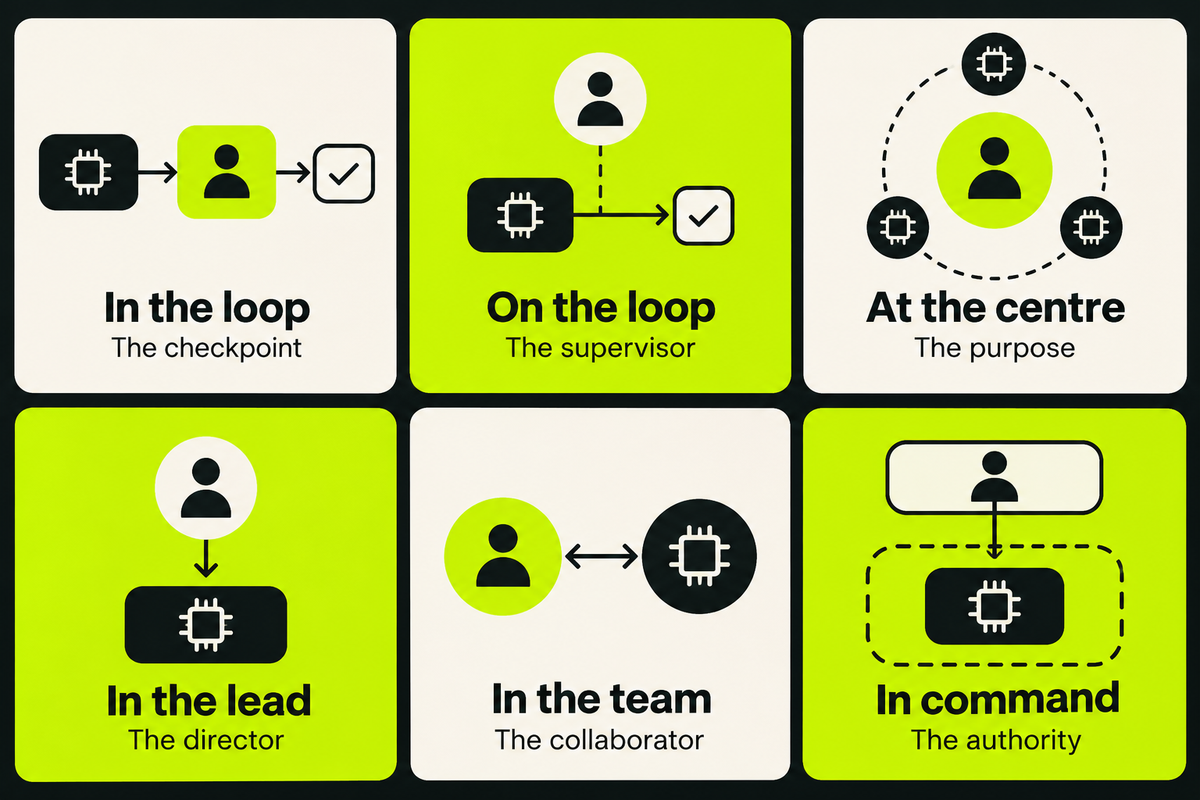
The human in the loop
Let's start with the familiar one.
Human-in-the-loop generally means that an AI system performs some work, produces a recommendation or reaches a decision point, and a human reviews the result before something happens.
Imagine an organisation using AI to sift 2,000 job applications. The system selects 40 candidates for interview. A recruiter reviews the shortlist, clicks approve and congratulations, we've successfully kept a human in the loop.
Except that our recruiter might have no idea why the other 1,960 applicants were rejected. They might lack the information to challenge the selection criteria, the expertise to identify bias or the time to examine anything beyond the shortlist.
Their involvement is technically genuine. Their ability to exercise meaningful judgement is considerably less certain.
There's a well-documented problem called automation bias, where people become overly reliant on automated recommendations. Add the pressures of organisational life, limited time, inadequate training and a management team expecting the promised efficiencies, and meaningful human oversight can rapidly deteriorate into a rather elaborate rubber-stamping exercise.
We have, of course, spent decades perfecting organisational processes in which people are nominally accountable for decisions they have precious little authority to influence. AI presents an exciting opportunity to industrialise the practice.
The uncomfortable question is whether the human is genuinely making a decision or simply giving the machine's decision a reassuringly human signature.
The human on the loop
Here, the relationship changes. Rather than approving individual outputs, the human monitors an AI system operating with greater autonomy, stepping in when something appears to be going wrong.
Think of a supervisor watching a production line, or someone overseeing an automated fraud detection system. The machine gets on with things while the human monitors performance and intervenes when necessary.
This can be perfectly sensible. Nobody needs a senior executive personally approving every routine transaction, provided the system operates within appropriate boundaries.
The difficulty comes when the person supervising the machine doesn't understand how it works, cannot see what it's doing or discovers that intervening requires considerably more than pressing a convenient red button.
As AI systems take on longer and more complicated tasks, the challenge becomes sharper. How do you supervise decisions being made faster than you can reasonably examine them? What happens when the warning signs are buried inside thousands of apparently successful transactions?
And when something finally goes spectacularly wrong, will the organisation investigate the design and governance of the system, or focus its attention on the unfortunate employee who was supposedly watching it?
One suspects the answer will depend heavily on who approved the original investment.
The human at the centre
This sounds much more appealing. Human-centred AI promises technology designed around people's needs, capabilities, wellbeing and rights.
Who could object?
Well, quite possibly some of the humans.
Organisations have a habit of discussing people as though they're a single, agreeable population with broadly compatible interests. The reality is usually considerably messier.
Consider an AI-enabled performance management system. For the executive team, it provides unprecedented visibility of workforce productivity. For managers, it offers convenient analysis and recommendations. For employees, it might mean every activity being monitored, assessed and compared against a set of criteria they had little say in designing.
All perfectly capable of being described as human-centred, depending on which human is holding the presentation clicker.
The same problem appears in recruitment, customer service, healthcare and almost every other area where AI decisions affect people who have no direct relationship with the technology.
Whose interests are being served? Who gets to decide what constitutes a good outcome? Who carries the consequences when the system performs exactly as intended, but the intention itself deserves questioning?
Putting humans at the centre requires us to think beyond the person operating the system. It means considering the people affected by its decisions, including those who may never know AI was involved.
For organisations already struggling to reconcile shareholder expectations, employee experience, customer needs and wider social responsibilities, this introduces some awkward questions.
Which might explain why it's easier to put human-centred on a slide than to work through what it actually means.
The human in the lead
Now we're getting somewhere.
A human-led approach gives people responsibility for determining the purpose of the work, setting priorities, making judgements and deciding what should happen. AI can provide analysis, generate options, challenge thinking and execute delegated tasks.
Imagine a communications director responding to an organisational crisis. AI might analyse developments, examine stakeholder sentiment, prepare briefing materials and suggest possible responses.
The director decides what the organisation should say, what it should acknowledge, what it can credibly promise and whether the proposed response demonstrates an ounce of judgement.
That distinction matters because leadership involves more than choosing between technically plausible options. It requires understanding context, weighing competing interests, recognising consequences and occasionally making decisions that aren't particularly popular.
Of course, being in the lead doesn't mean personally supervising every keystroke. Delegation remains a perfectly respectable management practice, and much of the point of AI is that machines can perform useful work without constant intervention.
The challenge is deciding which responsibilities can be delegated, under what conditions and with what safeguards.
A human leader who cannot explain, challenge or redirect the system they're supposedly leading is occupying a rather ceremonial position. We've all encountered organisational structures like that. The technology is new, but the management problem has a long and distinguished history.
The human in the team
This one is gathering momentum as organisations move from AI assistants to increasingly autonomous agents.
Microsoft's 2026 Work Trend Index explores the emergence of human-agent teams, with people directing AI agents that perform substantial pieces of work.
It's an intriguing proposition. Humans and AI working together, each contributing different capabilities. Tasks shared, expertise combined and work completed with greater speed and potentially better results.
There's just one small difficulty.
It turns out that adding AI to a human doesn't automatically produce a better-performing combination.
A 2024 meta-analysis published in Nature Human Behaviour examined 106 experiments involving humans and AI. The researchers found that human-AI combinations performed worse, on average, than the better of humans or AI working alone, although they generally outperformed humans working without AI. Outcomes varied according to the nature of the task and the relative strengths of each participant.
In other words, designing effective collaboration requires a bit more thought than putting everyone together and hoping for the best.
An insight that might usefully be extended to a significant proportion of corporate meetings.
There's another complication. AI agents can perform tasks, but they cannot carry organisational responsibility in quite the same way as human colleagues. They don't have professional reputations, careers, moral obligations or a mortgage riding on the decisions they make.
When an AI agent makes a costly mistake, we cannot summon it to a disciplinary hearing and expect it to reflect meaningfully on its behaviour.
Someone still has to own the consequences.
Which brings us to perhaps the most important position of all.
The human in command
This is where questions about participation become questions about power.
Human-in-command means people retain authority over the AI system, including deciding whether it should be used, what it can do and when it must stop.
Interestingly, these distinctions have existed for some time. The European Commission's 2019 ethics guidelines for trustworthy AI already distinguished between humans in the loop, on the loop and in command.
The EU AI Act goes further in setting specific human-oversight requirements for high-risk systems. Its Article 14 addresses matters including understanding system limitations, recognising automation bias, overriding outputs and interrupting operations.
There is something wonderfully practical about the requirement to be able to stop the machine.
Although the more demanding organisational question is whether the person responsible actually has the authority, information, confidence and institutional backing to do so.
Imagine an AI system recommending a decision that conflicts with an experienced professional's judgement. The professional challenges it, but the organisation has invested millions in the technology, redesigned its processes around the promised savings and made the anticipated productivity gains a board-level commitment.
How welcome is that challenge going to be?
What happens if the human insists on slowing things down? What if they believe the system is wrong but cannot conclusively prove it? What if challenging the machine becomes synonymous with resisting change?
These are questions about leadership, organisational culture and the distribution of power.
And they're questions that technology vendors, however capable, cannot answer on an organisation's behalf.
So where should we put the human?
I suspect we're asking slightly the wrong question when we argue about which of these positions is best.
There will be circumstances where humans need to approve individual decisions, others where monitoring is sufficient, and plenty where people and AI should work closely together. Some routine work can be automated almost entirely, while decisions involving significant human consequences warrant much closer scrutiny.
The appropriate arrangement depends on the nature of the work, the consequences of getting it wrong and the ability of people to exercise meaningful control.
But I think we need three things to be clear, regardless of the arrangement.
Purpose. Who determines what the system is trying to achieve, whose interests it serves and what a good outcome looks like?
Authority. Who can challenge its assumptions, change its instructions, override its conclusions or stop it altogether?
Participation. Where and how do humans contribute judgement, knowledge, creativity and expertise, and how do those contributions improve the result?
These questions belong in conversations about organisational design, governance, leadership, skills and accountability. They should be tackled when organisations decide what work AI will perform, rather than being retrofitted after the technology has arrived and everyone has been reassured that the humans are still involved.
Because there is a very real possibility that we'll spend the next few years carefully redesigning work around artificial intelligence while paying insufficient attention to the authority and capabilities of the people who remain.
We could end up with humans at the centre of our strategies, in the loop of our processes, on top of our dashboards and supposedly leading our AI agents, all while finding themselves increasingly unable to influence the decisions that matter.
Which would be quite an achievement.
We've spent an extraordinary amount of time discussing where to put the human in relation to artificial intelligence.
Perhaps it's time we decided what we actually want the human to be able to do.
And then gave them the power to do it.

Comments ()