
Lessons learned, then forgotten and repeated.
Another project closes. Another lessons learned spreadsheet is filed away. Six months later, the organisation makes precisely the same mistakes. Why are we so good at capturing lessons and so spectacularly bad at learning anything?
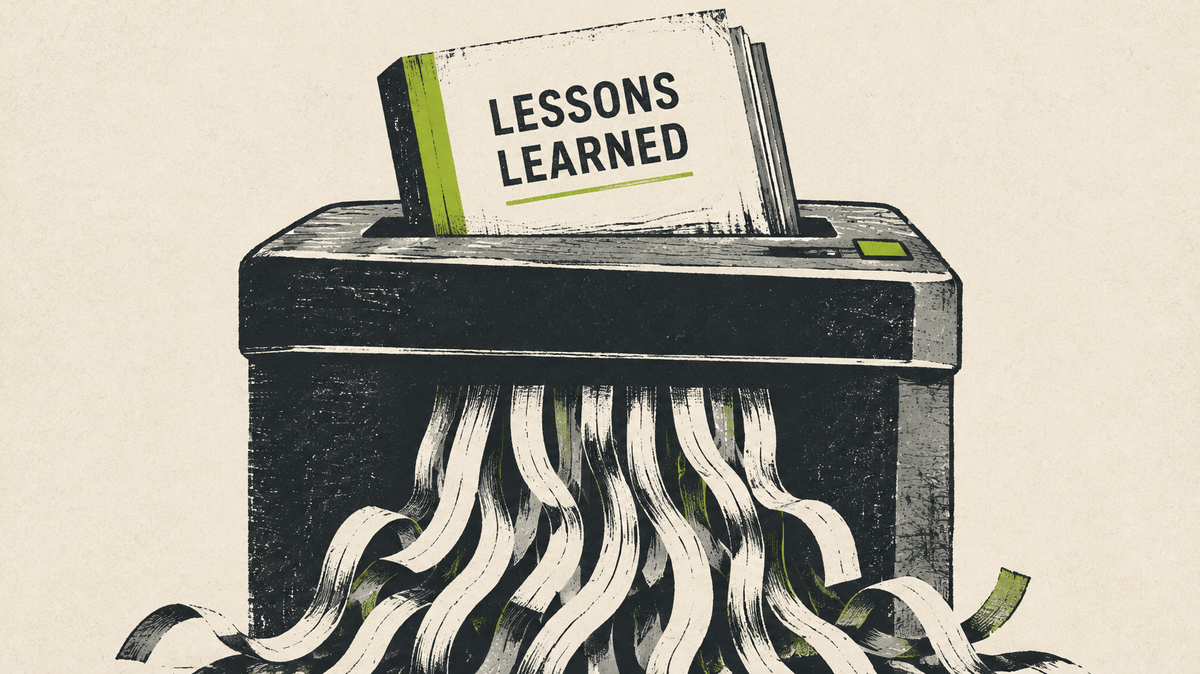
The curious organisational ritual of documenting everything that went wrong, in the hope that somebody, somewhere, might eventually do something about it.
There are few rituals in organisational life quite as reassuringly pointless as the lessons learned exercise at the end of a project.
After months, sometimes years, of missed deadlines, questionable decisions, heroic firefighting and the occasional tearful breakdown in a Teams meeting, everyone gathers to reflect on what could have gone better.
Out comes the spreadsheet. Four columns, perhaps five if the PMO is feeling ambitious. What happened? What went wrong? What did we learn? What should we do differently next time?
People dutifully contribute – it’s a workshop with brightly coloured Post-its after all! Some offer thoughtful observations about governance, resourcing and decision-making. Collect nods abound! Others finally get to air grievances they've been swallowing since the project began. The facilitator captures everything, thanks everyone for their candour and promises the findings will be shared.
The document is saved somewhere on SharePoint, the project is officially closed, and the organisation moves on.
Six months later, another project starts. Different name, different logo, possibly the same consultants. Within weeks, it's making precisely the same mistakes.
Still, at least we've got the spreadsheet.
The organisational memory of a goldfish
I've spent much of my career working in and around large change programmes, and one thing continues to fascinate me. Organisations can be extraordinarily good at documenting what they've learned and spectacularly bad at learning anything from it.
Some have enormous libraries of lessons learned reports, post-implementation reviews, gateway findings, independent assurance recommendations and programme closure documents.
Taken together, they probably contain enough wisdom to prevent a small organisational apocalypse. Unfortunately, the wisdom is usually stored in a folder last opened by someone who left in 2022.
The real problem is that lessons learned are typically treated as a project management deliverable rather than an organisational learning process.
The people who need to act on the findings are often entirely disconnected from those who have captured them. So the organisation collects knowledge without developing much of an appetite for using it.
Funny how the same lessons keep turning up
Look across enough programme reviews and you start to recognise the usual suspects.

Governance arrangements were unclear - check. Decision-making took too long - check. Stakeholders weren't sufficiently engaged - check. Resources were underestimated (if mapped at all) - check. Communications could have been better - check.
These are often perfectly legitimate findings. The trouble is that we've been writing them down for decades, generally while preparing to repeat them.
Take the perennial complaint about unclear decision-making.
Was the governance structure genuinely unclear? Were decision rights missing? Or did everybody know who should make the decision, but they never did?
Those are three rather different problems, requiring three different responses.
A lessons learned exercise that stops at the symptoms simply provides a tidier description of the mess.
To learn something useful, organisations have to examine the behaviours, incentives, assumptions and decisions that created it.
Which can become rather uncomfortable when the people responsible are still sitting around the table. Sometimes, dare I say, still at the head of the table!
The problem with waiting until the end
There's also something fundamentally peculiar about waiting until a programme has finished before asking what we've learned.
Imagine running a restaurant where customers complain about the food for eighteen months, but management decides to collect the feedback once the kitchen closes permanently.
Yet that is broadly how some organisations approach programme learning.
Of course, good programmes conduct retrospectives, assurance reviews and regular health checks throughout delivery. But too often, these become additional reporting exercises rather than opportunities to change course.
By the time the final review comes around, everyone knows exactly what went wrong. Most of them knew a year ago. The uncomfortable question is why the organisation couldn't respond while there was still something to save.
That requires a different relationship with feedback. Leaders need to be willing to hear unwelcome information, challenge optimistic reporting and distinguish genuine progress from the administrative appearance of progress.
It also requires permission to admit that something isn't working without immediately finding someone to blame. People tend to become much more enthusiastic about transparency when it doesn't come with the prospect of public execution.
Who actually owns the learning?
If organisations are serious about learning live from programmes and projects, the responsibility needs to extend well beyond the project team.
A few practical changes would make a considerable difference.
First, connect lessons to future decisions. Before approving a major programme, ask what previous programmes have taught the organisation about delivering similar change. Show how those findings have influenced the plan, budget, governance and resourcing. Make this part of the business case and assurance process.
Second, give systemic lessons an owner. If five projects have identified the same problem with decision-making, that is an organisational issue requiring executive attention. Another action assigned to a project manager isn't going to solve it.
Third, learn while there's still time to act. Reviews should produce decisions, changes and interventions during delivery. If an issue keeps appearing in reports without anything changing, somebody needs to explain why.
Fourth, follow the learning through. Don't measure success by whether lessons were captured or actions marked complete. Look for evidence that the organisation has changed its behaviour and that subsequent programmes are performing differently.
Finally, make room for uncomfortable truths. The most useful lessons often concern leadership behaviour, organisational politics, unrealistic expectations and decisions that were avoided. These are precisely the findings most likely to be diluted into something bland enough to survive a steering committee.
"Governance arrangements could be strengthened" sounds terribly professional. It may also be concealing the fact that three executives spent eighteen months arguing about who was in charge. (Don’t laugh – I was in that programme and still have the PTSD!)
Perhaps it's time we learned something
There is, of course, a legitimate value in giving people space to reflect at the end of difficult work.
Teams need to recognise how far they have come, what they've achieved, acknowledge what went badly and make sense of the experience. Sometimes simply having their frustrations heard matters and allows them to move on.
But catharsis is a poor substitute for organisational learning.
If the same problems recur across multiple programmes, despite repeated reviews and recommendations, the organisation has moved beyond an isolated project management problem. It has a problem with how it makes decisions, distributes authority, allocates resources, handles challenge or responds to evidence.
Those are leadership responsibilities. They deserve leadership attention.
Perhaps every programme board should be required to start its first meeting with a short presentation on the last three programmes that went wrong, what was learned and precisely what has changed as a result. I can dream!
I'd also like to see the occasional executive asked to explain why a lesson identified five years ago has appeared in every subsequent programme review.
That might concentrate a few minds.
Because there's a rather delicious irony in organisations that spend millions on transformation programmes while demonstrating an almost heroic determination to remain exactly as they were.
Next time somebody asks you to contribute to a lessons learned exercise, perhaps the first question should be: What happened to the lessons we learned last time?
And if nobody can answer, congratulations.
You've just identified your first lesson.


Comments ()