
Is AI taking the jobs or the blame?
Companies are announcing redundancies in the name of artificial intelligence. Some jobs really are disappearing. But when did a cost-cutting exercise become a technological achievement?
Companies are announcing redundancies in the name of artificial intelligence. Some of those jobs really are disappearing. But are cost-cutting exercises being billed as technological advancement?
There's a familiar ritual when a company announces hundreds of redundancies. Where bad news can be wrapped up as good news, it invariably is. The chief executive adopts a suitably sombre expression while the press release celebrates the opportunity to become a leaner, more efficient organisation.
Employees who've just discovered they're surplus to requirements are invited to appreciate the exciting direction of travel.
Lately, artificial intelligence has become a regular guest at these set-piece occasions, credited with making the company smarter and ready for tomorrow. Management has embraced the future, we're told, and investors can see a plan taking shape. Lovely for them.
But there's a question that doesn't get nearly enough airtime: are companies cutting jobs because AI can do the work or because they were going to cut the jobs anyway?
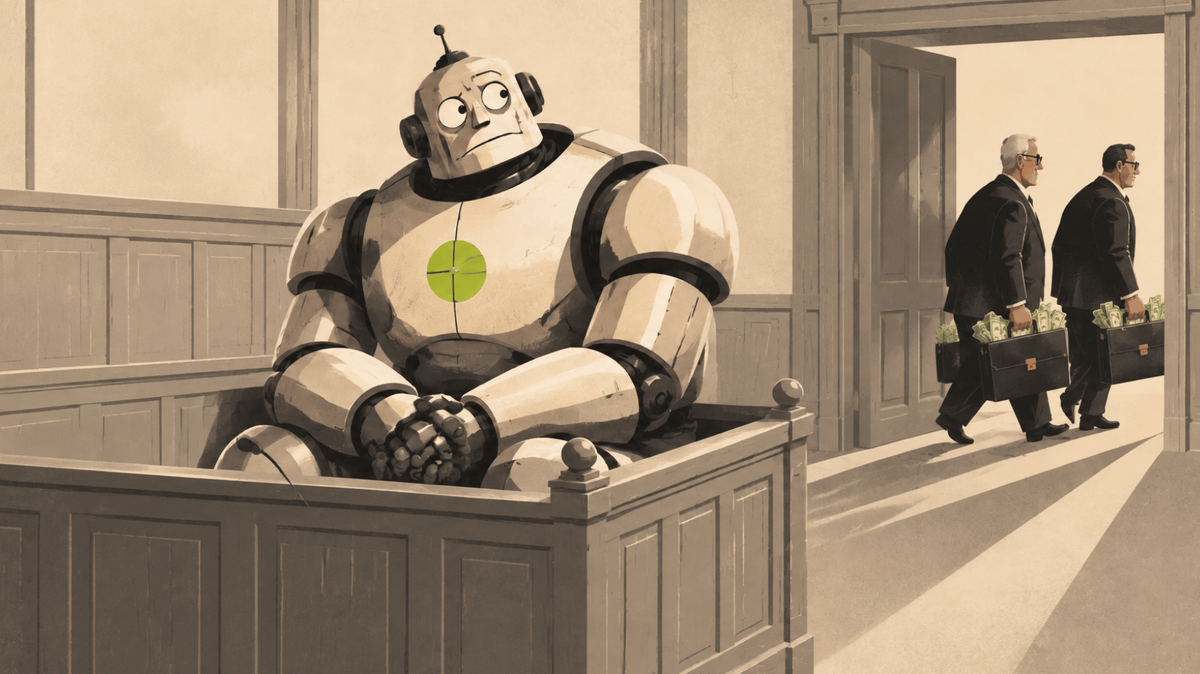
The robot made me do it
We've already got greenwashing. Now – I believe - we have AI-washing: exaggerating what artificial intelligence does, or how much of it a business uses. There's a particularly interesting version involving redundancies.
Imagine explaining to investors that sales have disappointed, costs have risen and the business hired too many people during the good times. Awks. Now imagine announcing an AI-led restructuring designed to position the company for the next era of productivity.
Same empty desks. Very different PowerPoint. And very different stock trade.
I'm not suggesting that every chief executive mentioning AI is lying. Some companies have genuinely automated work. Others are making a calculated bet that the technology will eventually allow them to operate with fewer people.
But those are different claims. So is the less glamorous possibility that business is slow and somebody needs to cut the wage bill. Before declaring the machine responsible, I'd like to see the evidence that it has actually completed its probation.
The numbers are not quite playing along
The US outplacement firm Challenger, Gray & Christmas tracks announced job cuts and the reasons employers give for them. Through October 2026, American employers attributed 121,401 planned cuts to AI, roughly 20% of the total.
That's serious. It's also a record of what companies said, rather than an independent check that an algorithm is doing the dismissed employees' jobs.
And here's the twist. In October itself, AI was cited for 1,265 cuts. Market and economic conditions accounted for 16,407. Economic conditions have now overtaken AI as the leading stated cause for the year.
The robot seems to have lost its place at the top of the redundancy presentation. Apparently, the economy has made an unwelcome return.
In Britain, the Office for National Statistics found that around 30% of businesses were using some form of AI in September 2026. Among AI-using businesses with at least ten employees, 6% said they'd reduced headcount because of it.
That doesn't account for jobs businesses chose never to advertise, or staff they didn't replace when they left. But it is some distance from the impression that a robotic workforce has already moved into Accounts and cleared out the desks.
Another UK government survey, published in October, found that half of AI-adopting firms reported productivity improvements, usually modest. Only 24% reported reduced operating costs, while 64% reported no immediate change.
That's a perfectly respectable start for a developing technology. As evidence for the sudden extinction of the payroll department, it's a little thin.
The revolution is apparently in next year's budget
An international study of nearly 9,000 senior executives, revised in October 2026, found that 78% of firms were using AI. The executives estimated that AI had added about 0.2 percentage points to annual labour-productivity growth over the previous three years. They expected around 0.6 percentage points a year over the next three.
There are real gains, and there may be much bigger ones ahead. The interesting thing is how often the benefits are pencilled in for the future while the workforce reductions are booked now.
I would love to see that business case.
The UK labour market has problems of its own. Vacancies fell to 691,000 in the three months to September, down 5.1% on the year. The ONS reports smaller employers citing higher labour costs as a reason for not recruiting.
We don't need to invent a recession to explain a difficult jobs market. The latest published quarterly figures still showed UK GDP growing in the first half of 2026. Businesses can freeze recruitment, shut underperforming units and trim costs without a robot having so much as logged on.
And perhaps that's part of the trouble. A recruitment freeze doesn't make for a particularly stirring announcement. "We've decided to spend less money" lacks the theatrical grandeur of "AI-powered organisational reinvention".
There is a genuine warning here
It would be foolish to conclude that AI isn't affecting employment. Stanford researchers studying US payroll records found that workers aged 22 to 25 in AI-exposed occupations had employment 19% below where it would have been if it had kept pace with their less-exposed peers by June 2026.
The research doesn't prove AI caused the whole gap. It also found no widespread economy-wide displacement. But the pressure on younger workers appeared to come primarily through weaker hiring, rather than mass dismissals.
That's the finding that should really concern us. Businesses may be removing the first rung of the career ladder while assuring everyone that senior talent remains their greatest asset.
Lovely. Who's going to become the senior talent in ten years? The graduate who was never hired?
AI is already changing tasks, especially routine work. In some organisations it will reduce the number of people required. In others it will help existing staff do more, or change the jobs rather than remove them. The effects will differ by industry, occupation and experience.
Which is exactly why the blanket "AI made us do it" explanation deserves a raised eyebrow.
Show us the work
If a company tells employees that AI is responsible for their redundancies, I'd like a few answers. What tasks have been automated? What can the systems actually do, to what standard, and who's checking? What savings have been measured rather than promised? What happens when the software gets something spectacularly wrong?
And was the workforce reduction already on the cards before someone discovered that "AI transformation" looked rather better on an earnings call?
No company owes the public its entire confidential operating model. But employees losing their livelihoods deserve an explanation that's more substantial than a reference to the future and a photograph of a glowing circuit board.
AI may become one of the biggest forces to reshape employment in a generation. Some of its effects are already visible. The evidence is also telling us that ordinary economics, decisions about recruitment and management expectations are mixed into the story.
It's entirely reasonable for leaders to make difficult decisions. It's reasonable to invest in technology and redesign jobs. It's rather less impressive to dress up a conventional budget cut as a triumph of machine intelligence.
Before we blame the robots, perhaps we could check whether they've actually turned up for their shift.

Comments ()